Design
Row spacing is a money decision, not a drafting decision
How far apart the rows sit decides how many kilowatts fit on your land and how much of every winter morning you give away.
The trade nobody explains
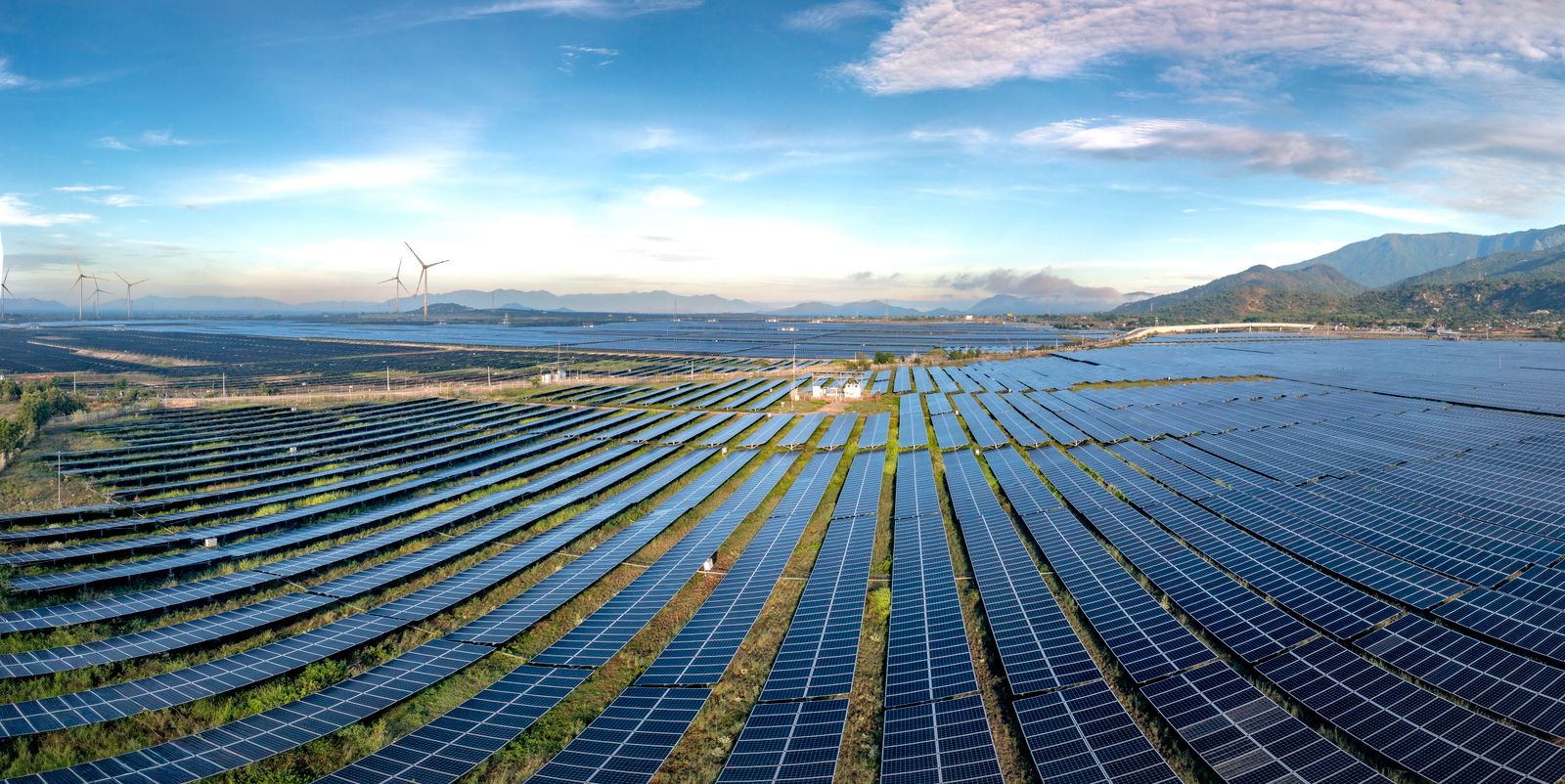
On a ground-mount site, the single most consequential number in the layout is row pitch: the distance from the front of one row to the front of the next. Everything else follows from it.
Push the rows together and you fit more kilowatts on the parcel. You also shade the bottom of each row with the row in front during the first and last hours of the day, worst around the winter solstice when the sun is lowest.
Spread them apart and every row sees clean sun almost all day. You just fit fewer of them, so the total kilowatts on the land drops and the cost per installed watt rises because the civil works, fencing and cabling stretch further.
Ground coverage ratio
The standard way to express this is ground coverage ratio, or GCR: the module area divided by the ground area it occupies. A GCR of 0.5 means the modules cover half the land. Higher GCR means tighter rows.
There is no universally correct GCR. There is a correct GCR for a given latitude, tilt, land cost and load shape. A site where land is effectively free and winter output matters should spread out. A site with a small parcel and a summer-dominated load can afford to tighten up.
What you should never accept is a GCR that was chosen because it is what the racking supplier's default template uses.
How we set it
We start from the winter solstice. At our latitude the sun is at its lowest declination around 21 December, and the shadow cast by a tilted row is at its longest. We pick a design window, commonly three hours either side of solar noon, and set row pitch so the rows are unshaded through that window on that day.
That geometry gives a minimum pitch. Then we model annual energy at that pitch and at wider and tighter values, and put the numbers side by side: kilowatts per acre, annual shading loss, and net delivered kilowatt hours per acre.
Net kWh per acre is the number that matters, and it is frequently not maximised at either extreme. On typical Kern County fixed-tilt sites at 25 degrees we land near a 3.8 metre pitch, which is a GCR around 0.58.
Wiring along the shade line
There is a second, cheaper lever. Inter-row shading arrives as a horizontal band creeping up the bottom of the row, so modules within a row are shaded together while modules in different rows are not.
Wire each string along the row rather than across rows and the whole string dims together, which a string inverter handles reasonably well. Wire across rows and you get one shaded module dragging down an otherwise healthy string, which is the worst possible arrangement.
This costs nothing. It is purely a decision about how the strings are laid out, and getting it wrong throws away energy that no amount of module-level electronics fully recovers.
- Set minimum pitch from the winter-solstice shadow across your chosen design window.
- Compare net kWh per acre across at least three pitches, not just kW per acre.
- Wire strings along rows so shading affects a whole string uniformly.
- Trackers need wider pitch than fixed tilt. Do not apply a fixed-tilt GCR to a tracker field.
This is a demonstration website. Figures quoted in this article are illustrative.