3410 Buck Owens Blvd, Suite 140, Bakersfield, CA 93308
Shared generation
One array, several meters
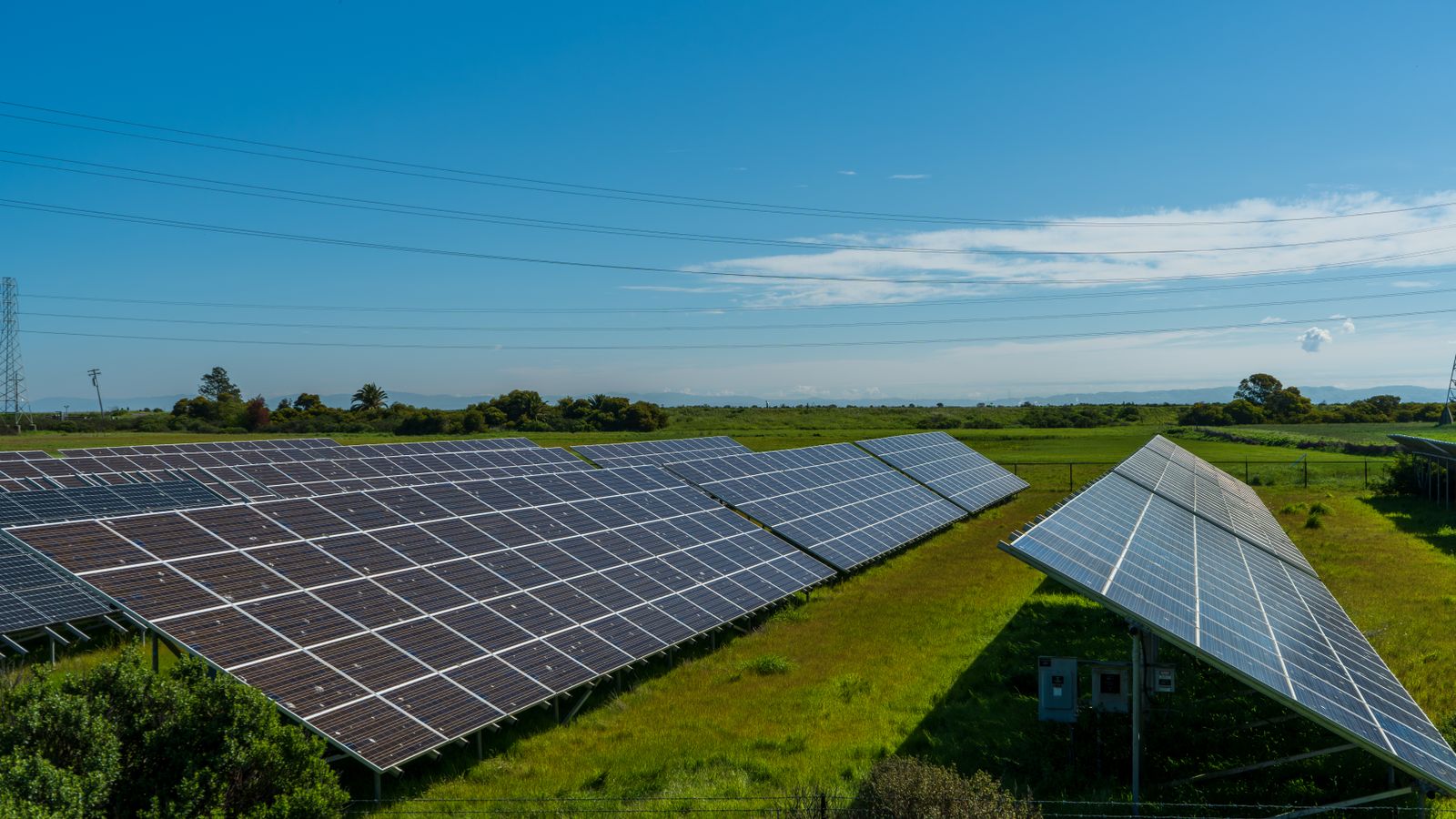
Not every business has a roof worth building on, or a load big enough to justify its own interconnection. A shared array gets several parties behind one well-sited system and one utility agreement.
Typical size
500 kW to 3 MW DC
Common hosts
Growers, districts, co-ops
Shared through
Utility bill credits
Hardest part
The agreement
The idea
Why several parties, one array
A small packing operation with a 90 kW load does not justify its own ground-mount field, its own interconnection application or its own maintenance contract. Three of them together might, particularly if one of the three has land sitting idle.
The economics come from scale. Interconnection costs, metering, civil works, fencing, access roads and the O&M contract are all substantially cheaper per kilowatt at one megawatt than at three hundred kilowatts. Sharing one well-sited array beats three poorly sited ones.
The other driver is siting. In agriculture the party with the best land for solar is frequently not the party with the biggest electricity bill. A shared array separates those two questions, which is exactly what makes it useful here.
Two roles
A host provides the site, the interconnection point and usually the land lease. A subscriber holds an allocation of the array's output and receives credits against their own utility account. One party can be both.
Who does what
Host and subscriber, side by side
Host
Provides the site
Land or roof with clear title and no conflicting use
An interconnection point with capacity on the circuit
Access for construction and for ongoing maintenance
A land lease or site agreement running the life of the array
Gets: lease income, usually its own allocation of output, and a use for ground that was producing nothing.
Subscriber
Takes an allocation
An eligible utility account in the right service territory
A share of the array's output, defined in kW DC or as a percentage
A subscription agreement with term, price and exit terms
A share of the O&M cost, proportional to allocation
Gets: bill credits against its own account without owning land, a roof or an interconnection.
Getting one built
How a shared project comes together
01
Find the site, not the subscribers
Interconnection capacity is the binding constraint. We screen candidate parcels against the utility hosting capacity map before anyone signs anything.
02
Size against the group's combined load
Every participating meter gets its interval data pulled. The array is sized to the aggregate, not to the land available.
03
Confirm the programme rules
Eligibility, allocation limits and credit mechanics vary by utility and customer class, and they change. This gets confirmed in writing before design.
04
Paper the agreement
Site lease, subscription terms, cost sharing, exit and reassignment, O&M obligation and end of life. Your lawyers, not ours.
05
Build it once, properly
Standard EPC delivery, with allocation metering and reporting configured so every participant can see their own share.
Answers
Shared solar: questions
Not covered here? Our engineers answer directly, not through a call centre.
Anyone with suitable land or roof and an interconnection point with capacity. In our territory that is usually a grower with a fallowed corner, a water district with basin margin land, or a co-op with a large packing shed roof.
Through the utility's own arrangement, not through private wires. Subscribers hold an allocation of the array's output and receive bill credits against their own accounts. Running a private line between properties is a different and much harder proposition.
Shared arrays in our territory generally start around 500 kW DC and run up to a few megawatts. Below that the fixed costs of interconnection, metering and administration are spread too thinly to be worth the complexity.
Not the engineering. It is the agreement: who pays for what, what happens when a subscriber leaves, how allocations are reassigned, who carries the O&M obligation and who owns the equipment at the end. We build the technical side and insist you get proper legal advice for the rest.
No. Community and shared solar rules in California have changed repeatedly and vary by utility and customer class. Confirm current programme terms before committing. Everything on this page is a sample for a demonstration site.
Have land but not the load? Or the load but not the land?
Those are the two halves of a shared array. Tell us which one you are and we will tell you whether the circuit can take it.